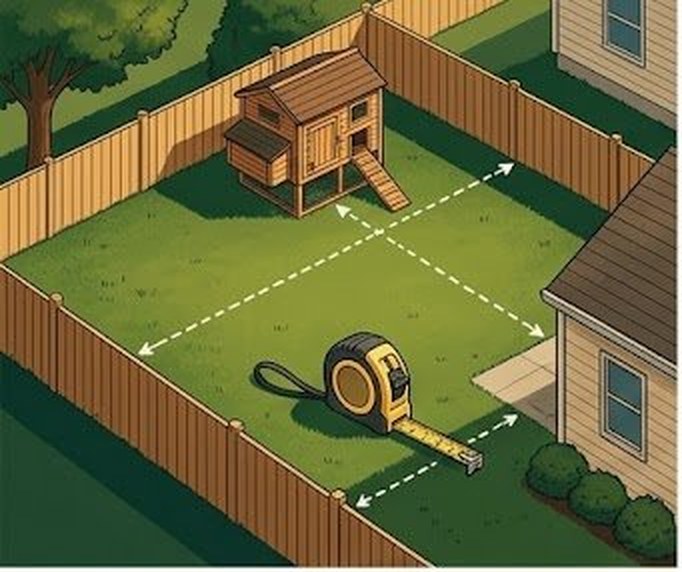
A "setback" is the minimum required distance between your chicken coop (or run) and something else — usually a property line, a neighboring home, or a shared fence. Setbacks exist because chickens produce odor and noise, and the city wants a buffer to protect neighbors from those nuisances.
The critical thing to understand: setbacks are measured from the coop, not from your house. Where you place the coop on your lot determines whether you comply, not how far your house is from the street.
What Gets Measured (and How)
There are typically three separate setback measurements in a chicken ordinance:
1. Setback from Property Line
This is the distance from the nearest wall of your coop or run to your property line. Common requirements range from 5 feet (very permissive) to 25 feet (strict). In dense urban areas like San Francisco, the requirement can be as low as 3 feet; in suburban sprawl cities, 20–25 feet is common.
How to measure: Find your property line (check your property survey or county GIS map) and measure from the outer wall of your proposed coop to that line. If you plan an open-air run attached to the coop, measure from the outer fence of the run.
2. Setback from Neighbor's Dwelling
Separate from the property line setback, many cities require a minimum distance from your coop to any neighboring home — not just the property line. This is often the stricter of the two requirements. Typical ranges: 20–50 feet from any neighboring residence.
This measurement crosses property lines. It's not about where your fence is — it's about the actual distance between your coop and your neighbor's house. In a dense neighborhood where houses are 15 feet apart, this requirement alone can make keeping chickens impractical.
3. Rear Yard or Zone Requirement
Most cities require the coop to be placed in the rear yard only — not the side yard or front yard. Some cities are more specific: the coop must be in the rear half of the lot, or at least X feet behind the midpoint of the house. This is a location requirement, not a distance requirement.
City-by-City Setback Examples
| City | From Property Line | From Neighbor's Home | Yard Requirement |
|---|---|---|---|
| Denver, CO | 5 ft | 15 ft | Rear yard only |
| Seattle, WA | 5 ft | No specific requirement | Rear yard only |
| Austin, TX | 10 ft | 25 ft | Rear yard |
| Portland, OR | 5 ft | No specific requirement | No restriction |
| Charlotte, NC | 25 ft | 25 ft from any residence | Rear yard only |
| Columbus, OH | 10 ft | 25 ft | Rear yard |
| Kansas City, MO | 10 ft | 30 ft | Rear yard only |
| Raleigh, NC | 15 ft | 25 ft | Rear yard |
| Minneapolis, MN | 5 ft | No specific requirement | No restriction |
| Salt Lake City, UT | 3 ft | No specific requirement | Rear yard |
These figures are based on publicly available ordinances as of 2025. Always verify with your city before building — ordinances change, and some cities have additional conditions not reflected in a summary table.
How to Check If Your Lot Can Comply
Before you plan anything, do this:
- Get your lot dimensions from your property survey or county assessor records.
- Note your property lines relative to your house and yard.
- Look up your city's specific setback requirements (use our Ordinance Finder).
- Sketch your lot to scale (graph paper works fine — 1 square = 5 feet).
- Mark the required setback distances from each property line and from the nearest neighbor's house.
- See if any area within your rear yard falls outside all those setback zones. That's where your coop can go.
People often forget that the "neighbor's home" setback is measured to the neighbor's actual building, not to your shared property line. On a standard residential lot where neighbors are 40 feet away, a 25-foot "from neighbor's dwelling" setback means your coop must be within 15 feet of the back of that neighbor's house — which in practice might mean you have no compliant space at all in a dense subdivision.
What If My Lot Is Too Small?
Small lots in dense urban neighborhoods often can't meet standard setback requirements. You have a few options:
Apply for a Variance
A variance is a formal exception to the zoning rules. You apply to the city's zoning board of adjustment, explain why strict compliance is impractical, and ask for a reduced setback. Variance hearings are public — neighbors can attend and object. Variances are approved at the board's discretion, not automatically.
Neighbor Agreement
Some cities accept a signed, notarized agreement from the affected neighbor waiving the setback requirement. This only works for setbacks that protect that specific neighbor — not general zoning setbacks. Check with your city planner before pursuing this.
Check for Urban Chicken Exceptions
A handful of cities have explicit "urban lot" or "small lot" provisions with reduced setbacks for properties below a certain square footage. Portland, OR and Seattle, WA are more permissive on this than average. Check your city's full ordinance text, not just summaries.
Setbacks for the Run vs. the Coop
Many ordinances specify setbacks for the "coop and run" together, measured from the outermost structure. Some distinguish: the enclosed coop might have a 5-foot setback, while an open-air run attached to it requires 10 feet. Read your ordinance carefully — "coop" sometimes means only the enclosed sleeping/laying structure, not the full outdoor enclosure.